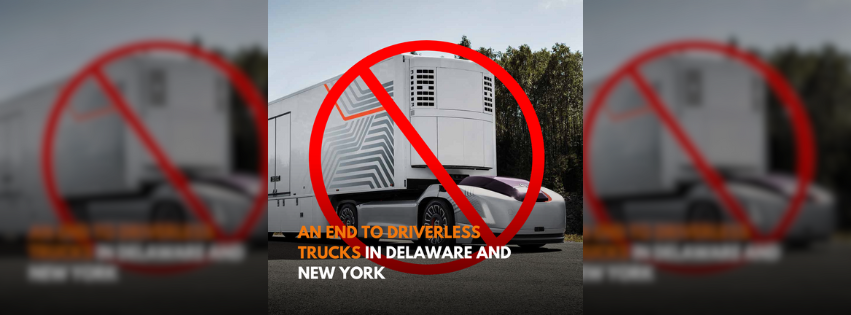
Lawmakers are pushing forward bills that would ban driverless big rigs from Delaware and New York roadways.
Delaware Bill To Require A CDL Holder In Self-Driving Trucks
Delaware State Sen. Spiros Mantzavinos introduced legislation (SB258) that would prohibit the operation of self-driving trucks without a human on board.
Specifically, the bill would ban any autonomous vehicle with a gross weight of 10,001 pounds or more from operation on a Delaware highway “for testing purposes, transporting goods, or transporting passengers” unless there is a human operator physically inside the vehicle.
The bill would also require that the human operator hold a commercial driver’s license that is valid for the type of vehicle being autonomously driven.
Another provision tucked into the bill would require the Delaware Department of Transportation to submit a report evaluating the performance of autonomous vehicle technology to the General Assembly and the Governor by January 1, 2029.
SB258 is out of committee and awaiting further action from lawmakers.
New York State Seeks Driverless Big Rig Ban
Lawmakers in New York State are working on similar legislation banning driverless autonomous trucks.
Companion bills A8621 and S7758 would amend the current state driver and traffic laws to require a licensed driver to be present inside of operating autonomous vehicles weighing ten thousand one pounds or more on public roadways.
Both bills remain under consideration by the committee.
Similar legislation to require human operators in self-driving semi trucks has been introduced in Indiana and California.
After all, the lawmakers understand that a truck driver can not be replaced with AI. And we are happy that proper legislation is being produced to protect truck drivers and their jobs.
To provide the best experiences, we use technologies like cookies to store and/or access device information. Consenting to these technologies will allow us to process data such as browsing behavior or unique IDs on this site. Not consenting or withdrawing consent, may adversely affect certain features and functions.
Functional
Always active
The technical storage or access is strictly necessary for the legitimate purpose of enabling the use of a specific service explicitly requested by the subscriber or user, or for the sole purpose of carrying out the transmission of a communication over an electronic communications network.
Preferences
The technical storage or access is necessary for the legitimate purpose of storing preferences that are not requested by the subscriber or user.
Statistics
The technical storage or access that is used exclusively for statistical purposes.The technical storage or access that is used exclusively for anonymous statistical purposes. Without a subpoena, voluntary compliance on the part of your Internet Service Provider, or additional records from a third party, information stored or retrieved for this purpose alone cannot usually be used to identify you.
Marketing
The technical storage or access is required to create user profiles to send advertising, or to track the user on a website or across several websites for similar marketing purposes.